


KUALA LUMPUR, Oct 10 — After more than two years of preparations to exit its Practice Note 17 (PN17) status, EA Technique (M) Bhd (EATech) aims for an upliftment by the first quarter (Q1) of 2025.
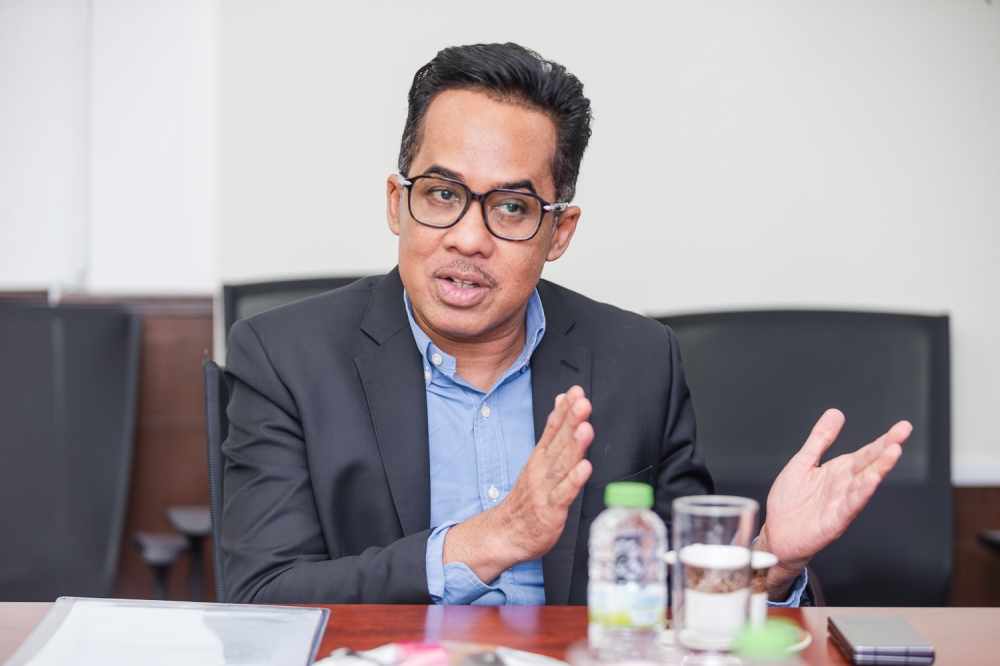
CEO Nasrul Asni Muhammad Dain said that the marine transportation, offshore storage of oil and gas, and provision of port marine services company is on track to meet the requirements for exiting PN17.
“Yes, many people want to know what’s next. For us, it is about uplifting the company from PN17, which requires two consecutive profitable quarters — specifically, Q3 and Q4,” Nasrul told Malay Mail in an interview at EATech’s headquarters.
“We have already achieved a utilisation rate of 97 per cent. Given our current order book and utilisation, we are confident in our ability to uplift the company from PN17 by recording profits in these two quarters.”
A company listed under the PN17 category lacks a core business or has failed to meet the minimum capital requirements or shareholders’ funds mandated by Bursa Malaysia.
Background on PN17 status
Nasrul provided a brief recap of the factors leading to EATech’s PN17 classification. The primary reason was a deterioration in shareholders’ equity, stemming from the inability to complete an EPCIC (engineering, procurement, construction, installation, and commissioning) contract to convert a tanker into a floating production storage and offloading (FPSO) facility.
“The project has been completed, but we had to pay a significant variation order to MMHE (Malaysia Marine and Heavy Engineering Holdings Bhd), resulting in our shareholders’ equity falling below the 25 per cent threshold imposed by Bursa Malaysia,” he explained.
“The project, awarded in 2015, marked EATech’s foray into EPCIC, which involves extensive engineering analysis and procurement, taking considerable time.
“Complications arose with the American charterer, leading to delays due to negotiations and the Covid-19 pandemic. Consequently, the project was only completed in 2021, incurring a RM150 million variation.”
Despite this setback, Nasrul said that EATech has been profitable for the past 30 years, barring the time spent on the EPCIC venture, which resulted in its PN17 status.
“Fast forward to today, we launched a scheme of arrangement, received court sanction in January 2023, and submitted a proposal to Bursa for approval. In May 2024, Bursa approved our regularisation plan, which was fully implemented by June 28.”
“Therefore, we anticipate exiting PN17 by January or February 2025,” he added.
Positive revenue and earnings
EATech’s confidence in exiting PN17 is reflected in its revenue, which reached RM61.81 million as of June 30, 2024, averaging about RM10 million per month.
“Over six months, we generated approximately RM60 million, slightly below expectations, but we maintained a gross profit of RM36.63 million, resulting in a gross profit margin of 41 per cent, which exceeds the industry average,” Nasrul said.
“With the completion of the regularisation plans, our EBITDA (earnings before interest, taxes, depreciation, and amortisation) — profit before tax and profit after tax — has improved significantly.”
A key factor in this improvement was the writeback of scheme creditors.
“The scheme creditors were written back by nearly RM150 million, resulting in a substantial profit increase primarily from this writeback.
“Importantly, our core profit stands at RM12.17 million for the past six months, comparable to last year’s performance without Nautica Tembikai,” he said.
With the regularisation plans complete, EATech’s working capital ratio improved from -RM238.9 million in 2023 to less than RM7 million in 2024.
“Our working capital ratio has risen to nearly unity at 0.94 per cent, up from 0.27 per cent in 2023, and our gearing ratio has improved from 1.44 per cent to 0.17 per cent, providing a solid foundation for future growth,” he added.
Regarding EATech’s order book, the company currently holds firm contracts worth RM136.3 million and optional contracts valued at RM281.2 million as of the second quarter of 2024 (2Q2024).
“We have renewed our contract for the floating liquefied natural gas (FNLG), so our remaining contract value totals RM200 million. Given that our turnover for six months is only RM16 million, this covers more than two to three years’ performance,” Nasrul said.
“I believe our charterers are confident in our performance,” he added, noting that EATech’s tender book is valued at RM492.2 billion, primarily from FSO contracts.
Future prospects
Despite its PN17 status, EATech has secured new and extended existing contracts worth over RM100 million.
“This demonstrates charterers’ confidence in EATech and illustrates how our performance has improved since our PN17 classification,” Nasrul said.
He highlighted the Sepat project, which utilises the Nautica Tembikai, where Petronas has shown interest.
“They are satisfied with the vessel’s condition and technical specifications and have requested us to present a technical and commercial proposal. As Petronas urgently needs a vessel to continue production, timing and cost are crucial,” he said.
“We anticipate securing this contract, with the tender process underway and an invitation to bid expected to be issued in the first quarter of next year.”
Nasrul further said that the employment of FSO Tembikai will significantly impact profits and income.
“This justifies our decision to retain the vessel for the past year to ensure we can fulfil the new contract and maximise profits,” he added.
Plans for diversification
Currently, 20 of EATech’s vessels are chartered to Petronas, with 30% not under contract, indicating a need for diversification.
“We are exploring appropriate charterers that do not compromise our paymaster’s strength, with Brunei Shell as a potential option,” Nasrul explained.
“Brunei Shell offers higher charter rates and long-term contracts, which are essential for sustainability and asset replenishment. This is an opportune time for us, provided we secure long-term contracts,” he noted.
In August 2024, EATech successfully registered as a vendor.
“Brunei Shell previously required us to collaborate with local Bruneians to operate there, but they opened the market in 2024.
“As a registered vendor, we can participate in various segments, including AHTS (anchor handling tug supply), diving support vessels, field support, multi-purpose vessels, shipyards, dry docks, and accommodation workboats,” he said.
“With several contracts expiring next year, we hope to secure better contracts based on the availability of our vessels.”
Mergers and acquisitions
While mergers and acquisitions are crucial for growth, Nasrul noted that they have been undermined in the past due to ship owners’ inability to agree on terms.
“We view mergers and acquisitions as a way to expedite growth, eliminating time-consuming processes. For example, the Sepat project took us about a year to secure the contract and an additional year to refurbish the vessel.
“The process for two tankers that secured a 10-year contract could take another one to two years, plus construction time of 18 to 24 months, exacerbated by the Covid-19 pandemic, extending the timeline to 36 to 48 months.
“Growth cannot rely solely on organic means — securing contracts, acquiring vessels, and fulfilling contracts. We also need to consider loan servicing and fluctuations in currency and interest rates, which impact investment costs,” he said.
According to Nasrul, several companies have expressed interest in EATech, with price evaluations currently underway.
“We hope to see a proposal materialise after we exit the PN17 list. We also aim to shift market perception of EATech, as being classified as PN17 implies a lack of capability, which the numbers do not support.
“Our primary focus is to establish the right business model, ensuring long-term sustainability while maximising profitability during favourable market conditions,” he said.
New management in place
Previously, EATech was owned by individuals and entrepreneurs, with majority shareholders being government-linked companies. The current shareholders are businessmen.
“This shift changes how we assess risk and future direction. Our previous management was comprised of founders, whereas now we have employed a new CEO and created additional posts, including an independent risk consultant to assess risks independently from management,” Nasrul said.
Supporting this statement, Datuk Mubarak Hussain Akhtar Husin, part of the new leadership team, affirmed the commitment to EATech’s long-term success.
“As new leaders, Datuk Lai Keng Onn and I are here for the long haul. We believe in EATech’s potential for continued growth,” he said.
Mubarak and Lai, through Voultier Sdn Bhd, completed the acquisition of a 51 per cent stake in EATech on June 27. Voultier now holds the majority stake after subscribing for 676.39 million shares as part of the company’s regularisation plan to address its PN17 status.
Voultier is 70 per cent owned by Mubarak, who is also a non-independent non-executive director of Kinergy Advancement Bhd, with Lai holding a 30 per cent stake as the executive deputy chairman and group managing director of KAB.
Following the share issuance, Johor Corp becomes EATech’s second-largest shareholder with a 21 per cent indirect stake, 20 per cent through Sindora Bhd and 1 per cent through Kulim (Malaysia) Bhd.


