










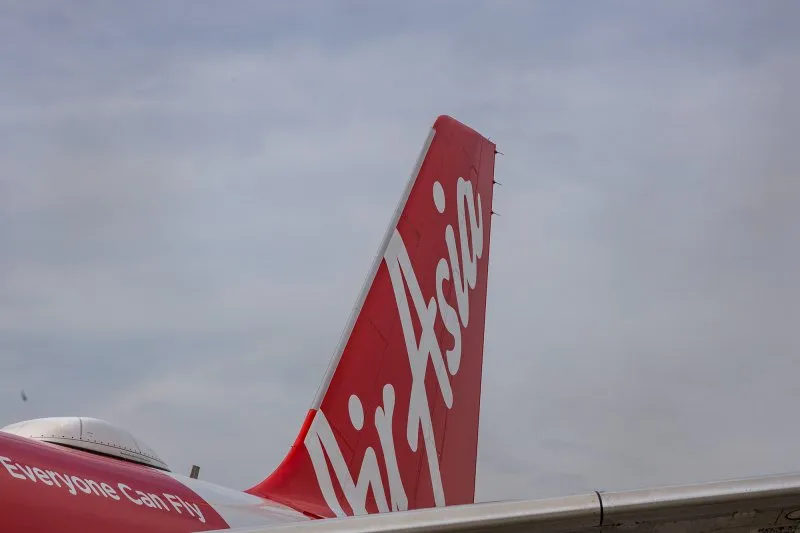


KUALA LUMPUR, Nov 26 — Domestic air connectivity remains a government priority, while AirAsia Group Bhd’s financial position continues to be monitored to ensure the country’s aviation ecosystem is not disrupted, Finance Minister II Datuk Seri Amir Hamzah Azizan said.
He stressed that the government had made no agreement or commitment to provide financial support to AirAsia, whether through loan guarantees or injections of public funds.
“Air connectivity, particularly to Sabah and Sarawak, remains a government priority, given the reliance of a significant proportion of air services in both states on AirAsia,” he said during a Special Chamber session in the Dewan Rakyat today.
Amir Hamzah was responding to concerns over AirAsia’s financial position and the possibility of government intervention raised by Datuk Muhammad Bakhtiar Wan Chik (PKR-Balik Pulau).
He said the government was seeking views from various stakeholders, including industry players and technical experts, to better understand the challenges facing the airline and identify possible approaches.
“If the company’s financial position continues to deteriorate and the government needs to consider other options in the future, any approach will prioritise the interests of the people and ensure the continuity of domestic air services,” he said.
Amir Hamzah added that any application for government support from companies in any sector would be assessed based on national and public interests, the government’s fiscal sustainability and the protection of public funds, in accordance with prevailing laws and procedures.
He said the government aimed to ensure a sustainable aviation industry structure, rational competition and financially sound airlines, without reliance on related companies or the need for future government intervention.
On AirAsia’s financial difficulties, he said the challenges were not new but dated back to the Covid-19 pandemic, when the airline faced financial constraints and various difficulties following its restructuring under PN17 status.
The situation had become more challenging following the West Asia crisis, which had driven aviation fuel prices to more than US$200 a barrel from about US$90 previously.
“Other airlines have also recorded losses under such circumstances,” he said.
AirAsia Group accounted for about 45 per cent of the 104.5 million passenger movements recorded at airports operated by Malaysia Airports Holdings Bhd in 2025, as well as nearly 60 per cent of domestic passenger movements, he said.
In 2026, AirAsia carried 62 per cent of passengers in Sabah and 70 per cent in Sarawak, based on the latest available data.
The airports with the highest AirAsia passenger shares included Sandakan (80 per cent), Sibu (76 per cent), Bintulu and Tawau (74 per cent each), Kuching (69 per cent), Miri (66 per cent) and Kota Kinabalu (61 per cent).
In Peninsular Malaysia, AirAsia also accounted for significant passenger shares in Johor (70 per cent), Terengganu (56 per cent), Langkawi (56 per cent), Alor Setar (49 per cent), Kelantan (46 per cent) and Penang (36 per cent).
At KLIA Terminal 2 (KLIA2), AirAsia Group accounted for 88 per cent of total passenger movements.
Responding to a supplementary question from Muhammad Bakhtiar on whether the government’s proposed approach would mirror its handling of Sapura Energy Bhd, now known as Vantris Energy Bhd, Amir Hamzah said one key consideration was to strengthen the company’s board and management while resolving its problems to build a more sustainable entity.
He said that if the government had to intervene in AirAsia’s case, it would adopt an approach similar to that used for Vantris.
“We must ensure that, in providing any assistance, the government receives priority over those who have already lent money to AirAsia.
“We want to ensure that public funds receive the priority they deserve, as the government would be stepping in as a rescuer in such circumstances.
“Our aim is not to protect shareholders, but to protect the people,” he said.
Amir Hamzah also said the AirAsia Group structure was complex, as it owned several airlines, each holding its own Air Operator Certificate in Malaysia, Thailand, Indonesia, the Philippines and Cambodia.
Capital A Bhd, meanwhile, is a separate listed company that provides essential services to AirAsia, including catering, aircraft maintenance and cargo services. — Bernama